
上篇最后提出的疑问是结构体gpio_chip中的成员函数set等是怎么实现的,在回答之前先介绍下gpio_desc这个结构体。
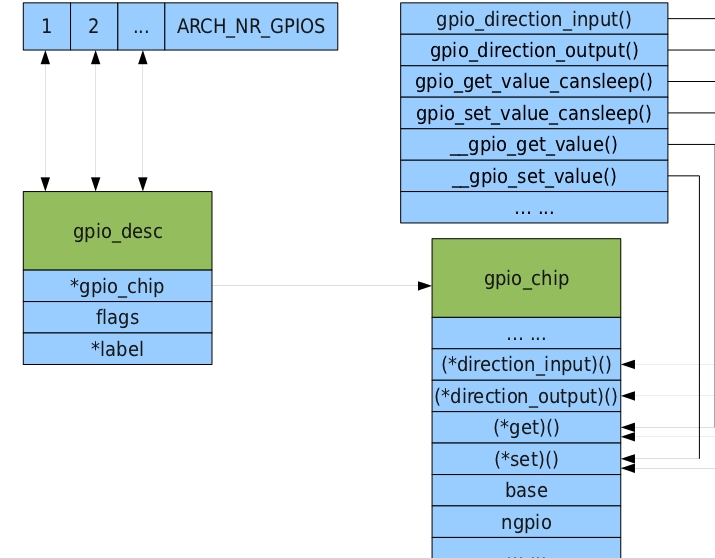
如上图所示,右上方部分为GPIO驱动对其它驱动提供的GPIO操作接口,其对应的右下方部分为GPIO硬件操作接口,也就是说对外提供的接口最终会一一对应的对硬件GPIO进行操作。
再来看左边部分,左上方部分为一全局数组,记录各个GPIO的描述符,即对应左下方的gpio_desc结构体,其中gpio_chip指向硬件层的GPIO,flags为一标志位,用来指示当前GPIO是否已经占用,当用gpio_request申请GPIO资源时,flags位就会置位,当调用gpio_free释放GPIO资源时,flags就会清零。label是一个字符串指针,用来作说明。
在软件上,我们首先通过函数gpiochip_add注册一个gpio_chip对应的gpio_desc到全局数组gpio描述符中。其中,一个描述符对应一个GPIO,所以如果我们要使用多个GPIO,那么就在gpio_chip结构体的ngpio指定个数,base为起始的GPIO号。
//每个引脚分配一个gpio_desc数据结构
struct gpio_desc {
struct gpio_chip *chip;
unsigned long flags;
};
/**
* struct gpio_chip - abstract a GPIO controller
* @label: for diagnostics
* @dev: optional device providing the GPIOs
* @owner: helps prevent removal of modules exporting active GPIOs
* @request: optional hook for chip-specific activation, such as
* enabling module power and clock; may sleep
* @free: optional hook for chip-specific deactivation, such as
* disabling module power and clock; may sleep
* @direction_input: configures signal 'offset' as input, or returns error
* @get: returns value for signal 'offset'; for output signals this
* returns either the value actually sensed, or zero
* @direction_output: configures signal 'offset' as output, or returns error
* @set: assigns output value for signal 'offset'
* @to_irq: optional hook supporting non-static gpio_to_irq() mappings;
* implementation may not sleep
* @dbg_show: optional routine to show contents in debugfs; default code
* will be used when this is omitted, but custom code can show extra
* state (such as pullup/pulldown configuration).
* @base: identifies the first GPIO number handled by this chip; or, if
* negative during registration, requests dynamic ID allocation.
* @ngpio: the number of GPIOs handled by this controller; the last GPIO
* handled is (base + ngpio - 1).
* @can_sleep: flag must be set iff get()/set() methods sleep, as they
* must while accessing GPIO expander chips over I2C or SPI
* @names: if set, must be an array of strings to use as alternative
* names for the GPIOs in this chip. Any entry in the array
* may be NULL if there is no alias for the GPIO, however the
* array must be @ngpio entries long. A name can include a single printk
* format specifier for an unsigned int. It is substituted by the actual
* number of the gpio.
*
* A gpio_chip can help platforms abstract various sources of GPIOs so
* they can all be accessed through a common programing interface.
* Example sources would be SOC controllers, FPGAs, multifunction
* chips, dedicated GPIO expanders, and so on.
*
* Each chip controls a number of signals, identified in method calls
* by 'offset' values in the range 0..(@ngpio - 1). When those signals
* are referenced through calls like gpio_get_value(gpio), the offset
* is calculated by subtracting @base from the gpio number.
*/
struct gpio_chip {
//这些函数实现在archarmmach-s5pv210gpiolib.c
const char *label;
struct device *dev;
struct module *owner;
int (*request)(struct gpio_chip *chip,
unsigned offset);
void (*free)(struct gpio_chip *chip,
unsigned offset);
int (*direction_input)(struct gpio_chip *chip,
unsigned offset);
int (*get)(struct gpio_chip *chip,
unsigned offset);
int (*direction_output)(struct gpio_chip *chip,
unsigned offset, int value);
int (*set_debounce)(struct gpio_chip *chip,
unsigned offset, unsigned debounce);
void (*set)(struct gpio_chip *chip,
unsigned offset, int value);
int (*to_irq)(struct gpio_chip *chip,
unsigned offset);
void (*dbg_show)(struct seq_file *s,
struct gpio_chip *chip);
int base;
u16 ngpio;
const char *const *names;
unsigned can_sleep:1;
unsigned exported:1;
};
下面分析gpio_desc中成员chip的成员函数的实现:
__init int s5pv210_gpiolib_init(void)//在Linux初始化期间,此函数就执行了
{
struct s3c_gpio_chip *chip = s5pv210_gpio_4bit;
int nr_chips = ARRAY_SIZE(s5pv210_gpio_4bit);
int i = 0;
for (i = 0; i < nr_chips; i++, chip++) {
if (chip->config == NULL)
chip->config = &gpio_cfg;
if (chip->base == NULL)
chip->base = S5PV210_BANK_BASE(i);
}
samsung_gpiolib_add_4bit_chips(s5pv210_gpio_4bit, nr_chips);
return 0;
}
void __init samsung_gpiolib_add_4bit_chips(struct s3c_gpio_chip *chip,
int nr_chips)
{
for (; nr_chips > 0; nr_chips--, chip++) {
samsung_gpiolib_add_4bit(chip);
s3c_gpiolib_add(chip);
}
}
void __init samsung_gpiolib_add_4bit(struct s3c_gpio_chip *chip)
{
chip->chip.direction_input = samsung_gpiolib_4bit_input;
chip->chip.direction_output = samsung_gpiolib_4bit_output;
chip->pm = __gpio_pm(&s3c_gpio_pm_4bit);
}
__init void s3c_gpiolib_add(struct s3c_gpio_chip *chip)
{
struct gpio_chip *gc = &chip->chip;
int ret;
BUG_ON(!chip->base);
BUG_ON(!gc->label);
BUG_ON(!gc->ngpio);
spin_lock_init(&chip->lock);// 初始化s3c_gpio_chip的自旋锁
if (!gc->direction_input)
gc->direction_input = s3c_gpiolib_input;//chip->direction_input
if (!gc->direction_output)
gc->direction_output = s3c_gpiolib_output;//chip->direction_output
if (!gc->set)
gc->set = s3c_gpiolib_set;//chip->set此处就回答了上篇的疑问
if (!gc->get)
gc->get = s3c_gpiolib_get;//chip->get
#ifdef CONFIG_PM
if (chip->pm != NULL) {
if (!chip->pm->save || !chip->pm->resume)
printk(KERN_ERR 'gpio: %s has missing PM functionsn',
gc->label);
} else
printk(KERN_ERR 'gpio: %s has no PM functionn', gc->label);
#endif
/* gpiochip_add() prints own failure message on error. */
ret = gpiochip_add(gc);
if (ret >= 0)
s3c_gpiolib_track(chip);
}
/**
* gpiochip_add() - register a gpio_chip
* @chip: the chip to register, with chip->base initialized
* Context: potentially before irqs or kmalloc will work
*
* Returns a negative errno if the chip can't be registered, such as
* because the chip->base is invalid or already associated with a
* different chip. Otherwise it returns zero as a success code.
*
* When gpiochip_add() is called very early during boot, so that GPIOs
* can be freely used, the chip->dev device must be registered before
* the gpio framework's arch_initcall(). Otherwise sysfs initialization
* for GPIOs will fail rudely.
*
* If chip->base is negative, this requests dynamic assignment of
* a range of valid GPIOs.
*/
int gpiochip_add(struct gpio_chip *chip) // 在gpio_desc[]中分配空间,并链接chip结构;注册一个gpio_chip对应的gpio_desc到全局数组gpio描述符中
{
unsigned long flags;
int status = 0;
unsigned id;
int base = chip->base;
if ((!gpio_is_valid(base) || !gpio_is_valid(base + chip->ngpio - 1))
&& base >= 0) {
status = -EINVAL;
goto fail;
}
spin_lock_irqsave(&gpio_lock, flags);
if (base < 0) {
base = gpiochip_find_base(chip->ngpio);// 这个函数在gpiolib.c中,在gpio_desc[]中分配chip->ngpio个空间(从最后往前分配),返回第一个index


上一篇:Linux下GPIO驱动(二) ----s3c_gpio_cfgpin();gpio_set_value();
下一篇:Linux下GPIO驱动(四) ----gpio_request();gpio_free();
推荐阅读最新更新时间:2026-03-25 11:02

 Linux技术手册
 【2025 DigiKey创意大赛】 学伴智盒 - 代码
 智能机械臂
智能机械臂 现代雷达系统的信号设计
- 用于 7VIN 至 16VIN、1.5V 和 1.2V 输出的 LTM4628EV DC/DC 模块稳压器的典型应用电路
- 使用 Analog Devices 的 LTC3728LIGN 的参考设计
- DER-406 - 适用于 A19 灯的 5.76 W 高 PF 非隔离降压-升压型 TRIAC 调光 LED 驱动器
- ADR5045B 5V 输出精密微功率并联模式电压基准的典型应用
- LT3970EDDB-3.42 2.5V 降压转换器的典型应用
- MC78M08BDTG 8V 电流调节器的典型应用
- LT1021DCN8-5 精密电压基准的典型应用
- DER-282 - 100W, 扁平(11 mm), LLC DC-DC转换器
- REF193 低压差开尔文连接电压基准的典型应用电路
- LT3088EM 线性稳压器用于添加软启动的典型应用
 BFR340T






 京公网安备 11010802033920号